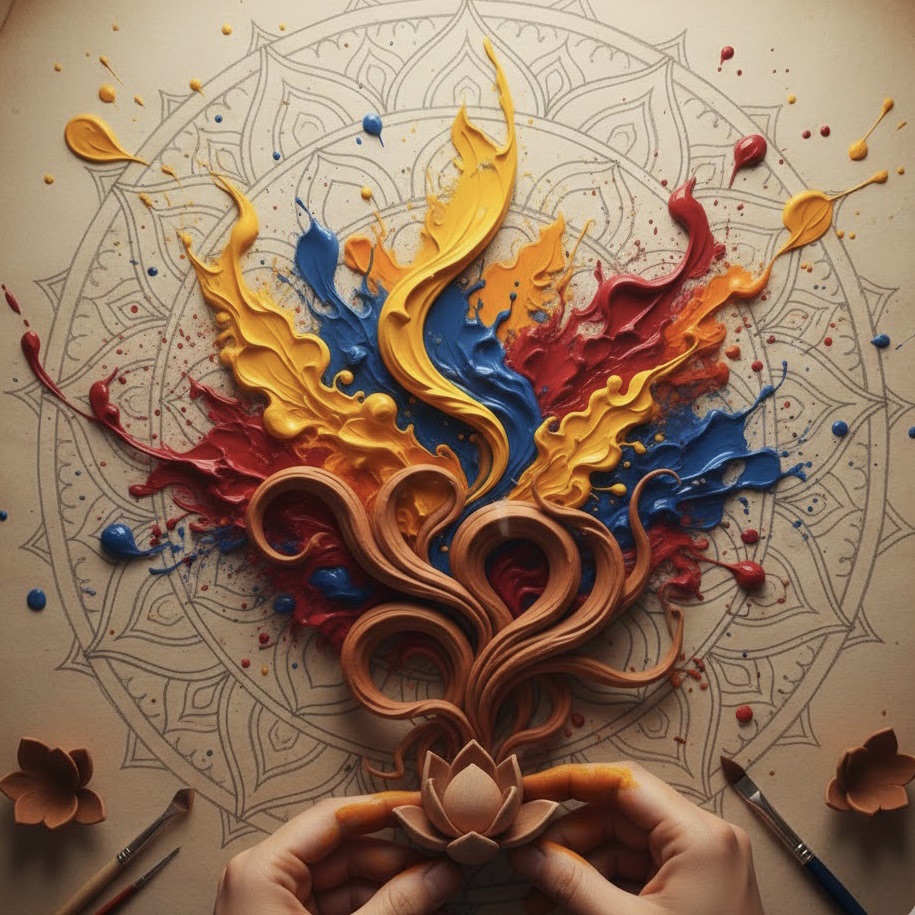
The Unspoken Language of Healing: Why Non-Clinical Art Therapy is Essential to India’s Wellness Mandate
The talks heard around mental well-being in India has shifted profoundly. Moving to just concern to a national imperative, it is backed by policies like the NEP 2020. This shift has created an urgent demand for accessible, culturally relevant therapeutic tools.
Enter Indian Non-Clinical Art Therapy (INCAT)—a powerful methodology that uses creative expression as a direct pathway to emotional health.
Beyond Words: What is Non-Clinical Art Therapy?
NCAT is different from formal psychotherapy mainly because of its setting and focus. These sessions are framed as creative or therapeutic workshops designed for organizations such as schools, colleges, NGOs, and corporate environments.
The core goal is not to diagnose or treat clinical disorders, but to provide proactive support centered on:
- Stress relief through creative activity.
- Improving creativity and boosting self-expression.
- Building emotional awareness and mindfulness.
By engaging with materials like color, texture, and movement, Art Therapy opens a crucial, non-verbal space for healing where individuals can express what words often cannot.
As one expert notes, art can act as a “bridge between what’s going on within the person and the verbal world”. This process allows emotions, memories, and insights to surface safely and gently.
A Method Rooted in Indian Wisdom
INCAT’s efficacy finds deep philosophical resonance in India’s ancient wisdom traditions. Modern psychology often struggles to define the subjective experience of the Mind, yet traditions like Vedanta and Yoga offer sophisticated, non-dualistic models of reality.
Philosophers have suggested that systems like Vedanta function less like Western religion and more like “psychotherapy”.
The efficacy of expressive art and mindfulness—which are central to rigorous NCAT training—can be seen as rooted in this non-dual philosophy. By engaging non-verbally with art, an individual can bypass the limitations of the intellectual, dualistic mind and explore deeper realities of the self (Atman), validating Art Therapy as a direct tool for self-inquiry and transformation.
In fact, some of India’s most intensive Art Therapy and Arts-Based Therapy (ABT) courses, are explicitly rooted in neurobiology, theories of human development, and Indian Mind Training principles.
This deliberate integration ensures that professional training is not only rigorous but ethically and culturally relevant to the Indian context.
The Future of Professional Practice
While the number of formally qualified art therapists in India is currently limited high quality professional training institutes are rapidly emerging.
Specialised certificate courses provide mental health professionals and educators with the experiential learning and ethical supervision necessary to integrate art-based interventions.
NCAT practitioners are now invaluable resources for schools and organizations implementing national wellness programs, offering the targeted emotional support and stress relief that complements classroom learning. By embracing this powerful, indigenous-validated methodology, India is ensuring that its youth develop not only intellectual competence but the crucial character, empathy, and psychological resilience needed for the future.
29/11/25 – Hemali Koringa
References
- https://sociallysouled.com/products/art-therapy-course
- https://www.miap.institute/
- https://anantaraa.org/abt-course/
- https://pmc.ncbi.nlm.nih.gov/articles/PMC3705680/
- https://www.ijhssi.org/papers/vol9(11)/Ser-2/L09117275.pdf
- https://www.tandfonline.com/doi/full/10.1080/17454832.2024.2416904
- https://www.iipr.in/art_therapy.php
- https://indianexpress.com/photos/lifestyle-gallery/national-education-day-why-students-mental-health-matters-10359226/
 Indian Non-clinical ART THERAPY
Leave a comment