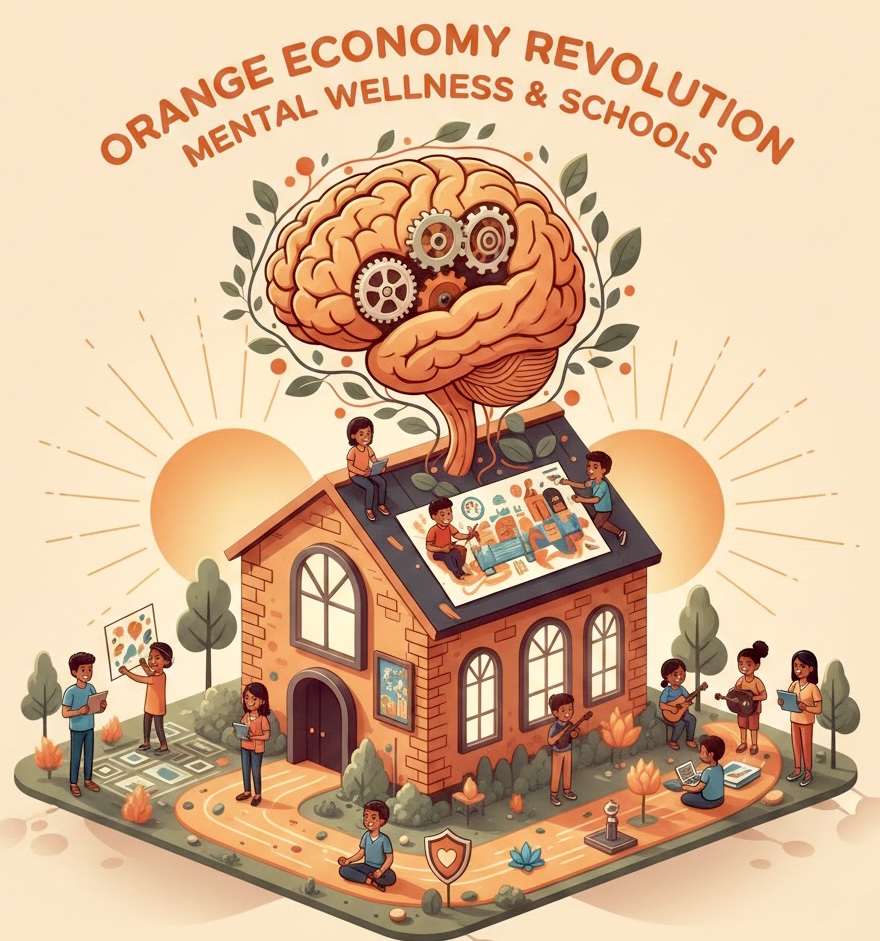
Something very special happened in the 2026 Union Budget. For the first time, our government didn’t just talk about building roads. They didn’t just discuss factories. They talked about creativity as national infrastructure.
If you are a parent or a teacher, this is the news you have been waiting for. If you believe that painting and storytelling can heal the mind, this is the news you have been waiting for. Here is why the “Orange Revolution” is the best thing to happen to Indian wellness and education in decades.
1. What is the “Orange Economy”? (The Juice of the Mind)
The term Orange Economy was popularized by former Colombian President Iván Duque Márquez and his advisor Felipe Buitrago. They chose the color orange because it has always been linked to culture, youth, and happiness.
Think of a real orange fruit. To get the juice, you have to squeeze it. The Orange Economy is the same: it is a system where we “squeeze” our intellect and imagination to create value. Unlike coal or oil, which will one day run out, our creativity is a limitless resource. Globally, this sector is worth over $2 trillion and supports nearly 50 million jobs.
The Spiritual Connection:
In our Indian traditions, orange is the color of the Sacral Chakra (Svadhisthana). This is the energy center in our body that controls our creative flow and emotional health. By naming this new economy “Orange,” the world is giving recognition to the creative energy inside us. This is what will power the future!
2. Why this Budget is a “Win” for Schools
The government is spending ₹1.39 lakh crore on education this year. Here is how that money helps our kids through Art Integrated Learning (AIL):
- 15,000 Creator Labs: Schools will get special labs for Animation, Gaming, and Comics (AVGC). This gives kids a professional place to “draw their feelings” using digital tools.
- A Six-Fold Leap for Innovation: Funding for Atal Tinkering Labs jumped from ₹500 crore to ₹3,200 crore. These labs are all about Project-Based Learning (PBL)—learning by doing rather than just reading.
- Teacher Power: New committees are working to upgrade SCERTs (teacher training centers). This guarantees that every teacher knows how to use art as a “pedagogical tool.” It makes subjects like Math and Science joyful.
3. Non-Clinical Art Therapy is Now a Real Career
For years, Art Therapy was seen as just a “hobby.” But the 2026 Budget changes the rules of the game:
- 100,000 New Professionals: The government will train 1 lakh people in “Allied Health” over five years.
- A Seat at the Table: For the first time, “Applied Psychology and Behavioural Health” is listed. It is now recognized as an official professional category. This marks a significant recognition. Even more excitingly, the National Commission for Allied and Healthcare Professions (NCAHP) has officially started the registration for “Movement Therapists.” This category includes Art, Dance, and Movement Therapists.
- The Wellness Infrastructure: A second NIMHANS will be built in North India, and 1.5 lakh caregiverswill be trained in wellness and yoga. This creates a massive network where non-clinical art therapists can work to help people stay happy and mentally fit.
4. Why will this work? (Real-Life Examples)
You might ask: “How does a painting help an economy or a child?” Here is how:
- Example 1: The “Mithila Mapping” Project. Imagine a Grade 4 student who finds Math boring. Through iCraft-style projects, they paint a Madhubani fish using geometry and fractions. They learn Math, they celebrate Indian heritage, and the act of painting lowers their stress. This is what we call “Indian Ethos and Equity” in action.
- Example 2: The Bullying Comic. A student who is too shy to talk about being bullied has another option. They can use the new AVGC Labs to create a digital comic about a hero. This hero stands up for others. This “non-verbal” expression heals the heart while teaching them a high-paying job skill.
- Example 3: Low-Cost Healing. Our research shows that effective therapy doesn’t need expensive machines. We can use local-specific, cost-effective resources like clay, natural dyes, and recycled paper. By doing so, we can bring mental wellness to every village in India.
5. Saving Our Ancient Secrets (Gyan Bharatam)
The government is spending ₹60 crore to digitize over 1 crore (10 million) ancient manuscripts.
These old books contain the wisdom of Vedanta, the Upanishads, and the Panchatantra. In our therapy sessions, we can now use these stories as “mirrors.” A child can draw a character from the Panchatantra to understand how to make wise decisions (Viveka). We are using 2,000-year-old secrets to solve 21st-century stress!
A Vibrant, Resilient India
The 2026 Budget proves that India is ready to lead the world in the Orange Economy. We are building a “Wellness Infrastructure” where our Sacral Chakra’s creative flow is the engine of growth.
A child might be making a “Value Quilt” out of scrap fabric. Alternatively, a professional “Movement Therapist” might be helping a patient. Despite the context, the message is the same: Creativity is our superpower. Let’s pick up our brushes and paint a future where every Indian is creative, resilient, and happy!
The Intersection of Imagination and Innovation
The Orange Economy—the vast landscape of creative industries, culture, and intellectual property—is more than just a financial sector. It acts as a catalyst for a psychological shift in how we approach development. When we bring this revolution into our schools, we move beyond traditional rote learning. We enter a space where creativity is the primary currency for well-being.
A New Paradigm for the 21st Century School
Our current educational models are often built on rigid structures that can inadvertently stifle the human spirit. The “Orange Revolution” in schools proposes a different path:
- Creativity as a Buffer: Engaging in the arts and digital creation offers students a non-clinical outlet. It helps them process emotions. It also aids in building resilience.
- Economic Empowerment: We train students in the creative arts. This preparation helps them for a global economy that increasingly values unique human insight over automated tasks.
- Holistic Environments: Transforming schools into creative hubs reduces the “clinical” feel of mental health support. This transformation makes wellness a natural byproduct of a vibrant, active community.
Bridging the Gap: Art, Tech, and the Mind
The image above illustrates this ecosystem perfectly. It is a world where the school is no longer just a building, but a flourishing garden of ideas. Every activity contributes to a “mental wealth.” This includes digital design, traditional music, and mindful reflection. These activities prepare students for the complexities of the modern world.
“The Orange Economy isn’t just about making art; it’s about making a life that is expressive, connected, and emotionally grounded.”
 Indian Non-clinical ART THERAPY
Leave a comment