Beyond the Textbook: Why Art-Integrated Learning is a Human Necessity in the NEP Era
By Hemali Koringa | INCAT.BLOGS
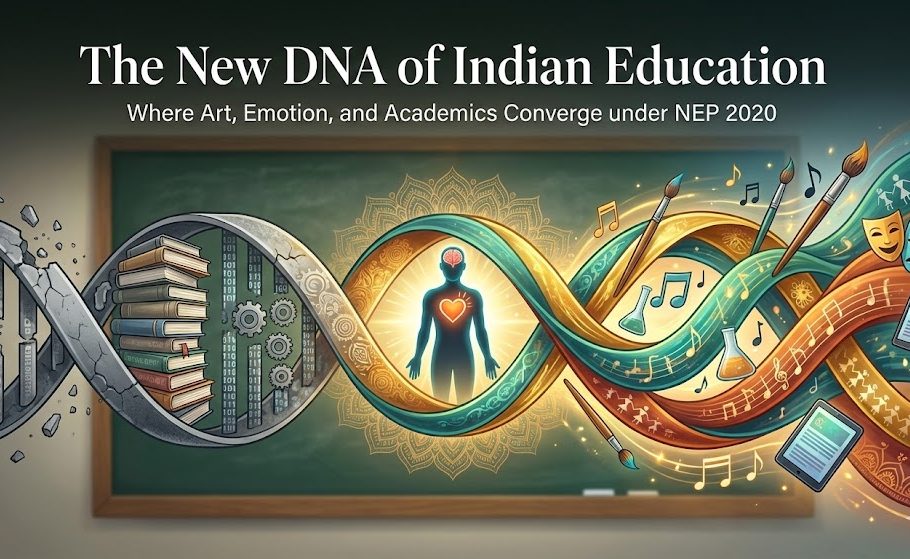
Mumbai, February 2026 — We are in the early months of the 2026 academic year. A quiet but profound revolution is taking place in schools across India. The conversation is shifting. It is no longer just about completing the syllabus. It focuses on the quality of the human being that emerges at the end of the school day. We see the rise of a new educational DNA under the framework of the National Education Policy (NEP) 2020. In this new framework, Art-Integrated Learning (AIL) and Social-Emotional Learning (SEL) are not “extras.” Instead, they are considered essentials.
The End of the “Art Period” Myth
For decades, art in schools was confined to a single hour a week. It was seen as a period for “fun.” Meanwhile, the “real” subjects like Math and Science took center stage. The NEP 2020 has dismantled this wall. Today, we recognize that Art is a pedagogy. It is a way of thinking. When a student uses sketching to understand the life cycle of a plant, they aren’t just “doing art.” Role-playing helps them comprehend a historical treaty. They are engaging in high-level cognitive processing. They are moving from rote memorization to conceptual mastery.
A Multi-Disciplinary Mandate
This transition is not the burden of the art teacher alone. The vision for a modern, competitive India relies on teachers embracing creative expression. Math, Physics, and Language teachers are all part of this vision. Why? Because the human brain is not a set of isolated boxes; it is a web of connections. By integrating the arts into “hard” subjects, we make learning stick. We make it visible. Most importantly, we make it inclusive for every type of learner in the classroom.
The ROI of Empathy
But beyond academic scores, why is this a “must” for every human being? This is where Social-Emotional Learning (SEL) comes in. In 2026, the global economy isn’t just looking for calculators; it is looking for collaborators. SEL is the “emotional fitness” that enables a student to manage exam anxiety. It helps them resolve conflict with peers. It also builds the resilience needed for a rapidly changing world. A child who can regulate their emotions is a child who can concentrate on their future.
The Vision Forward
For school management committees and educators, the path is clear. We must stop viewing the arts and emotional intelligence as “soft skills.” They are, in fact, the hardest skills to master and the most valuable assets a student can possess. We strive toward the vision of a “Viksit Bharat.” Our success will not be measured by the height of our buildings. Instead, it will be gauged by the depth of our students’ character. It will also be judged by the breadth of their creativity.
The pulse of our nation’s future is beating in these holistic classrooms. It’s time we start listening.
 Indian Non-clinical ART THERAPY