MUMBAI, FEBRUARY 2026 — The first term of the 2026 academic year is gaining momentum. A familiar tension is rising in staff rooms. The National Education Policy (NEP) 2020 mandates holistic development. Many educators still ask a pointed question: “If I spend time on ‘feelings,’ won’t my Math scores suffer?”
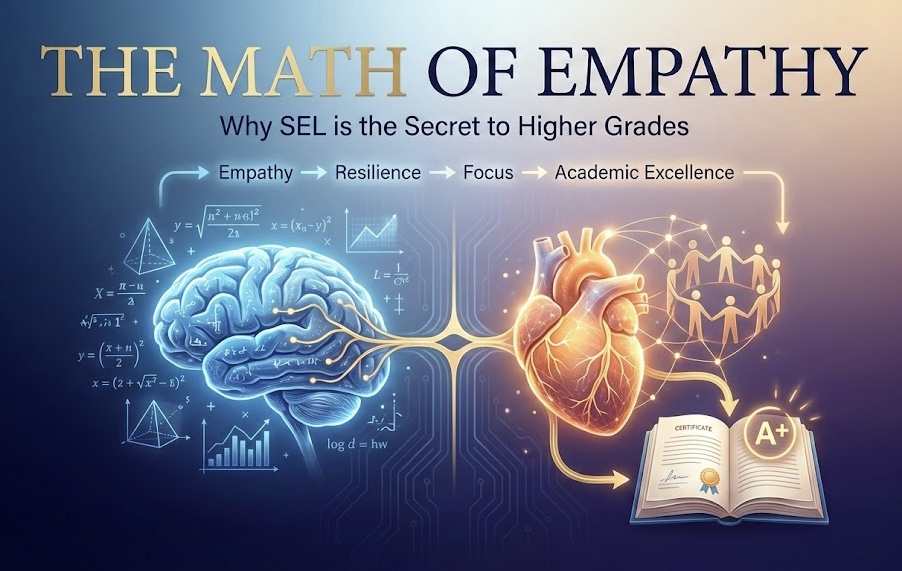
The data, however, tells a different story. We are discovering that empathy isn’t a distraction from the syllabus. Instead, it is the operating system that allows the syllabus to be processed.
The “Cognitive Bandwidth” Constraint
Traditional schooling often assumes that the brain is a vessel. We can simply pour information into it, regardless of the student’s internal state. But cognitive science has presented us with a clear reality: A brain in stress cannot learn calculus.
When a student is anxious, the Amygdala takes over. This might happen due to exam pressure, social conflict, or a lack of self-confidence. The Amygdala is the brain’s emotional alarm. This effectively “hijacks” the Prefrontal Cortex, the area responsible for logic, problem-solving, and high-level reasoning.
By teaching Social-Emotional Learning (SEL), we aren’t just being “nice.” We are clearing the neural pathways for academic performance. We are giving students back their cognitive bandwidth.
The ROI for STEM Teachers
For the Science, Technology, Engineering, and Math (STEM) departments, SEL is the ultimate performance enhancer. Why? Because the “hard” sciences require the highest levels of frustration tolerance.
Empathy + Logic = Resilient Problem Solving
Self-Regulation: A student who can manage their frustration doesn’t give up when a Physics equation gets tough.
Growth Mindset: SEL teaches students to view a “wrong” answer as a data point, not a personal failure.
Collaboration: Scientific progress in 2026 is rarely a solo endeavor. It requires the ability to communicate, listen, and iterate with a team.
Measuring Success in 2026
In the Viksit Bharat of 2026, our competitive edge lies in Human Intelligence. As AI takes over rote calculation, our ability to collaborate becomes important. Empathy and regulation under pressure are now our most valuable currencies.
Our success will not be measured by how many facts a student can recall. The recall is not as important as how effectively they can apply those facts. It will be gauged by how effectively they can apply those facts while navigating the complexities of human emotion.
We do not have to choose between the heart and the grade. We use the heart to unlock the grade.
The Final Pulse
Emotional regulation is the new academic gold standard. Start the investment today.
 Indian Non-clinical ART THERAPY